Story by Basak Ashley Sahin.

Dr. Amrit Singh is an Assistant Professor in the Department of Anesthesiology, Pharmacology and Therapeutics, and a Principal Investigator at the HLI.
As a new Principal Investigator, Amrit has actively engaged with both the trainees and center committees, making his nomination as the EDI Spotlight of the Quarter well-deserved. His presentation for the EDI seminar series, Resonant Realities: From Individual Story to Collective Empathy, was truly inspiring, showcasing his deeply human and humble approach. Here’s a closer look at Amrit and his connection to EDI.

The journey of becoming a better human being…
Amrit expresses that EDI represents the journey of becoming a better human being. He views EDI as an overarching concept that transcends the specific words of the acronym. To him, it embodies a blend of various interconnected ideas, including:
- Fostering a respectful environment
- Promoting justice
- Enhancing accessibility
- Cultivating a sense of belonging
And much more…

When the aim is learning…
Amrit’s exploration of Equity, Diversity, and Inclusion (EDI) began when his department head encouraged him to join the department’s EDI Committee. This opportunity introduced him to significant topics he had not previously examined in depth, such as professionalism, learner accommodations, trauma-informed learning, accessible environments, and more.

Humility, Curiosity, and a Willingness to Listen…
Amrit suggests that when engaging in EDI work, we should approach it with humility, curiosity, and an openness to listen. He highlights the importance of acknowledging that we won’t always possess all the answers, as many challenges may lie beyond our personal experiences.
For Amrit, impactful EDI initiatives demand reflection, a receptiveness to feedback, and a dedication to implementing practical changes that foster more respectful, accessible, and inclusive environments.

Goodness in people, Goodness in Pho…
Amrit’s willingness to be good, do good deeds, and see the good in people is truly inspiring. If you’re hoping for a random encounter, Amrit often visits Pho Goodness on Davie, and his trainees can vouch for this!

Story by Basak Ashley Sahin.

Tao Sun is a Data Analyst (Bioinformatician) in Dr. Ying Wang’s lab at HLI.
With experiences at multiple institutions in Canada and internationally, working in diverse, multidisciplinary teams, Tao has built a career at the intersection of medicine, bioinformatics, statistics, and data science; focusing on cardiovascular and bioinformatics research through RNA-Seq and spatial transcriptomics.
Tao holds an MD, PhD, and MSc, with a background in clinical medicine, cardiovascular surgery research, and statistics. Over the past decade, Tao has developed expertise in biostatistics and bioinformatics, focusing on cardiovascular studies, RNA sequencing, and spatial transcriptomics.
A typical day in Tao’s life as a Data Analyst involves analyzing cardiovascular datasets, developing computational pipelines for RNA-Seq and spatial transcriptomics, and collaborating with colleagues on findings that advance understanding of heart and lung diseases.
The secret to scientific discovery is collaboration
Tao is passionate about the intersection of science and collaboration, focusing on transforming intricate data into meaningful biological insights while partnering with a variety of researchers and clinicians. Tao feels fulfilled when data-driven discoveries positively impact patients and improve public health.

Tao’s equity, diversity, and inclusion (EDI) journey commenced at Queen’s University in 2008, progressed at Western University starting in 2011, and thrived at McMaster University alongside the Unifor Union.
How experiences turn into advocacy
EDI has fostered inclusive spaces where Tao felt comfortable sharing ideas and learning. Working in diverse environments has broadened Tao’s perspectives, enriched collaborations, and strengthened resilience as a researcher navigating different institutional and cultural contexts.
Having encountered and navigated challenges as an international scholar and professional in Canada before joining HLI, particularly in terms of cultural adaptation and acknowledgment of previous experiences, Tao is inspired to foster a more inclusive environment for others.
At HLI, Tao hopes to design and support initiatives that amplify diverse voices and ensure an inclusive research culture.
A moment of pride
One of Tao’s proudest moments was supporting EDI-focused initiatives at McMaster University with the Unifor Union, where collective advocacy highlighted systemic challenges faced by underrepresented groups.

Small actions, lasting impacts
Tao recommends that anyone striving to enhance EDI should begin with small, consistent efforts. Simple actions, such as actively listening and amplifying underrepresented voices, and acknowledging contributions can create significant and lasting change.

Outside of the lab
Outside work, Tao enjoys reading, sports, and exploring Vancouver’s food scene. Tao likes spending time with friends, exploring nature around Vancouver, playing sports like ping pong and swimming, and discovering local Asian cuisine spots that which remind him of home and connect him to Vancouver’s multicultural community.
Story by Basak Ashley Sahin. Edited by Tiffany Chang.

When Asma Tanveer moved to Canada from Pakistan 10 years ago, she brought with her a master’s degree in biotechnology and a passion for scientific research and its impact. Like many newcomers, she faced significant challenges in navigating credential recognition, an unfamiliar academic system, and the absence of accessible professional networks.
Asma is one of many trainees at HLI with a unique background and perspective. In June 2025, she was named HLI’s Equity, Diversity, and Inclusion (EDI) Person of the Quarter in recognition of her leadership, mentorship, and efforts to foster a more inclusive environment.
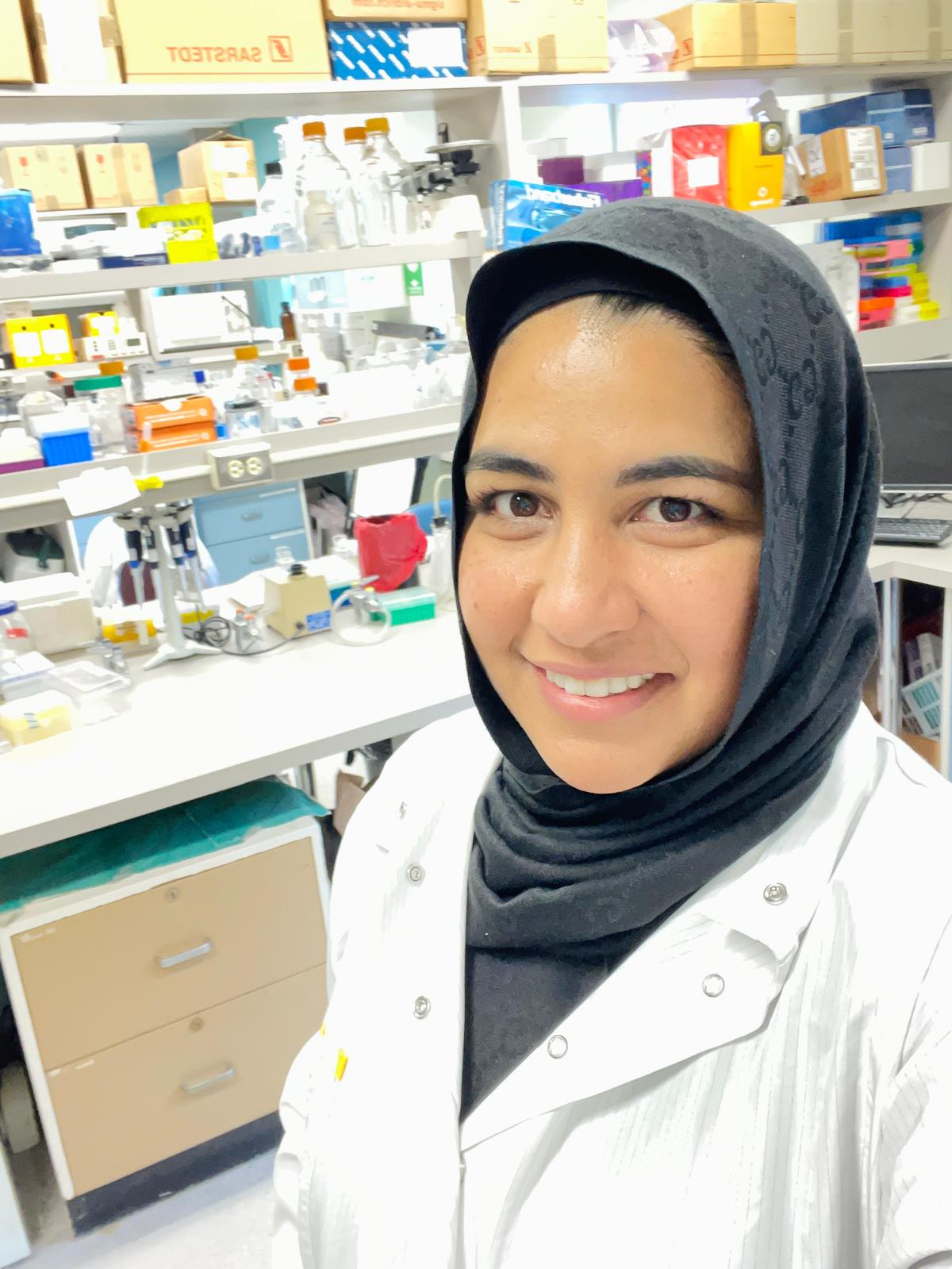
At HLI, Asma works on airway epithelial repair and drug responses in asthma models as a master’s student in the Dorscheid Lab in UBC’s Experimental Medicine program. She also contributes to outreach and mentorship through initiatives such as Geneskool: a Genome BC program that introduces high school students to genomics and biomedical research.
From personal experience to advocacy
Asma’s commitment to EDI is shaped by lived experience. “My commitment to EDI began with the realization that too many talented individuals are overlooked – not for lack of ability, but because of who they are. Having felt that invisibility myself, I was driven to act,” she says.
Since then, she has mentored women in science, contributed to outreach through Geneskool, and advocated for inclusion grounded in empathy and shared experience. “For me, EDI isn’t optional. It’s a responsibility to ensure everyone feels they belong.”
Her journey into biomedical research was shaped by mentors who offered support at key moments. She first connected with Dr. Sima Allahverdian, a former HLI researcher, through a mutual friend. Though Dr. Allahverdian had already relocated to Toronto, she generously offered guidance – recommending courses and encouraging Asma to pursue volunteer experience.
That connection led to an introduction to Dr. Gurpreet Singhera, a research associate at HLI and a manager of the Bruce McManus Cardiovascular Biobank. “Even with her full schedule, Dr. Singhera always made time for answering my emails or meeting for a coffee chat,” she says. “She helped me strengthen my application, introduced me to Dr. Del Dorscheid, and believed in my potential to contribute meaningfully to the lab.”
With their support, she joined the Dorscheid Lab as a graduate student. Looking back, she credits both mentors not only for their guidance but for modelling what inclusive mentorship looks like in practice. “Their belief in me made a lasting impact. It’s part of why I now feel so strongly about creating that same sense of welcome for others.”
Leading by example
Asma’s advocacy now includes mentoring early-career researchers, promoting inclusive lab practices, and contributing to outreach that reflects the diversity of communities served by HLI.
“EDI has shaped not just how I work, but why I work,” she says.“It’s helped me find mentors who value potential over credentials and communities that see difference as a strength. “
She believes inclusion begins with how people are welcomed and supported. “Sometimes, what holds people back isn’t a lack of talent, but a lack of confidence or the right platform to express themselves,” she says. “When we support others with respect and openness, we create the kind of environment where people feel seen – and when they feel seen, they shine. When they shine, we all benefit.”
That perspective was reinforced during a Mentor Walk session hosted by Tech2Step, where she was invited to speak on a science outreach panel. As the only racialized woman present – visibly Muslim, hijab-wearing, and of Pakistani and South Asian background – Asma says the moment reminded her that she was representing more than just herself.
“After the session, several attendees, especially young women, told me how much it meant to see someone who looked like them in that space. I realized I was part of something larger, a reflection of what’s possible.”
Creating space for others to thrive
Asma encourages others to take action, regardless of role or title.
“Start where you are. Improving EDI doesn’t require a title – small, consistent actions can create meaningful change. Your intention matters. The way you speak, listen, and show up shapes how others feel.”
She shares that there are many ways to contribute. She regularly offers coffee chats, connects friends and peers with professional opportunities, and volunteers as a parent at her children’s Catholic school and church events. She also leads an Islamic teaching circle in Vancouver – a space for reflection, learning and community building.
“In all spaces, I try to be of service in ways that honour others’ values and experiences – just as I hope mine are respected,” she says. “And I encourage others to do the same.”
Outside of the lab
Outside of her research and outreach work, Asma enjoys spending time with her husband and two daughters. They often play badminton together or unwind over a meal at The Old Spaghetti Factory, a family favourite in Vancouver.
“My family is my greatest source of strength and motivation,” she says.
Through her work, mentorship and advocacy, Asma Tanveer continues to advance both scientific inquiry and a culture of belonging, demonstrating that research and equity go hand in hand.